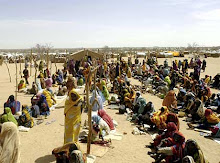
MUKJAR, Sudan: Uncovered by a restless wind, skulls and bones poke above the thin dirt in this corner of Darfur, lying surrounded by half-buried, rotting clothes.
A short, bearded man named Ibrahim, 42, scratches through the sand. He is a quiet and serious, close to tears. There are other, bigger grave sites elsewhere, he says, but the bones he is looking at are those of 25 people who he is sure are his friends and fellow villagers.
Some of them were dragged from the prison where he was held and were axed to death, he says.
Ibrahim is showing the burial ground to an Associated Press reporter and photographer, the first Western journalists to visit this remote town in more than a year. The western Sudan is about to enter a new phase in its four-year-old conflict — one that villagers fear may encourage more killing.
Sudan's government recently agreed to let in 3,000 U.N. peacekeepers, a fraction of the 22,000 mandated by the Security Council last August. The deployment could still take months and villagers here fear the government will want to get rid of all witnesses to atrocities before peacekeepers move in.
"We need them to come as fast as possible, because we're all in danger," said Ibrahim. Read more >>>>>>>>>>>>>>>>>>>>>>>>>>>>
Saturday, May 26, 2007

Sunday, February 25, 2007
The tragedy of Darfur - double standards being applied
Why is it that - in contrast to the attention given to the Middle East conflicts - Arab media and politicians are largely ignoring events in Darfur? Moataz El Fegiery and Ridwan Ziyada look for answers
For many people in the Arab world the "humanitarian catastrophe" unfolding in Darfur just doesn't exist - and the simple reason for that is that the Arab media has ignored it. So it's little wonder that there has been no unease or disapproval voiced at the ignorance exhibited by the Arabs on the subject of crimes against humanity in this region of Sudan.
What makes things worse is a suspicion that what we are faced with here is the kind of unscrupulousness that borders on a denial of history; one need only recall the role of some Arabs in the African slave trade.
Let's assume for the moment that Arab governments' displaying a less than clear cut commitment to the human rights issue in Darfur is only to be expected - in fact it is just about the last thing an Arab government is going to place on its list of foreign policy priorities - but what about Arab journalists, intellectuals, political activists and artists? How is their behaviour, particularly those whose job it is raise public awareness of such things on behalf of the United Nations, to be explained?
Turning a blind eye on the Darfur crisis
How can they justify their silence on events in Darfur? No explanation, no honestly expressed shock at what is happening in Darfur has been forthcoming. The only rent in this curtain of silence being the statement of 17 October 2006, when at least some few Arab intellectuals were prepared to express their disapproval of "the silence of the Arab world in the face of the humanitarian catastrophe in Darfur." Read more >>>
For many people in the Arab world the "humanitarian catastrophe" unfolding in Darfur just doesn't exist - and the simple reason for that is that the Arab media has ignored it. So it's little wonder that there has been no unease or disapproval voiced at the ignorance exhibited by the Arabs on the subject of crimes against humanity in this region of Sudan.
What makes things worse is a suspicion that what we are faced with here is the kind of unscrupulousness that borders on a denial of history; one need only recall the role of some Arabs in the African slave trade.
Let's assume for the moment that Arab governments' displaying a less than clear cut commitment to the human rights issue in Darfur is only to be expected - in fact it is just about the last thing an Arab government is going to place on its list of foreign policy priorities - but what about Arab journalists, intellectuals, political activists and artists? How is their behaviour, particularly those whose job it is raise public awareness of such things on behalf of the United Nations, to be explained?
Turning a blind eye on the Darfur crisis
How can they justify their silence on events in Darfur? No explanation, no honestly expressed shock at what is happening in Darfur has been forthcoming. The only rent in this curtain of silence being the statement of 17 October 2006, when at least some few Arab intellectuals were prepared to express their disapproval of "the silence of the Arab world in the face of the humanitarian catastrophe in Darfur." Read more >>>
Tuesday, January 16, 2007
Sudan govt bombs areas in Darfur despite truce
By Opheera McDoom
KHARTOUM (Reuters) - Sudanese government planes bombed Darfur rebel areas on Tuesday despite a declared truce, rebels said.
"The Antonovs bombed our areas of Amrai and Anka," Darfur rebel commander Jar el-Neby told Reuters from North Darfur, near the affected areas.
He said it was not immediately clear whether any civilians were killed but said dozens of cattle died in the bombardment.
An army spokesman denied the bombing. "No Sudanese planes have moved in Darfur or in Chad in the past two days," he said.
Chadian officials on Monday said Sudanese military aircraft had violated Chad's air space.
Experts estimate 200,000 people have been killed and 2.5 million driven from their homes in four years of rape, pillage and murder in Darfur, which Washington calls genocide. Read more >>>
KHARTOUM (Reuters) - Sudanese government planes bombed Darfur rebel areas on Tuesday despite a declared truce, rebels said.
"The Antonovs bombed our areas of Amrai and Anka," Darfur rebel commander Jar el-Neby told Reuters from North Darfur, near the affected areas.
He said it was not immediately clear whether any civilians were killed but said dozens of cattle died in the bombardment.
An army spokesman denied the bombing. "No Sudanese planes have moved in Darfur or in Chad in the past two days," he said.
Chadian officials on Monday said Sudanese military aircraft had violated Chad's air space.
Experts estimate 200,000 people have been killed and 2.5 million driven from their homes in four years of rape, pillage and murder in Darfur, which Washington calls genocide. Read more >>>
Sunday, December 31, 2006
AU: Sudan bombs the people of Darfur
KHARTOUM, Dec 31 (Reuters) - Sudan has bombed Darfur rebel areas, a day after African Union officials visited the insurgents and secured their commitment to a ceasefire, an AU statement said on Sunday.
Luke Aprezi commands a 7,000-strong African Union force in Darfur which, hampered by lack of equipment and funds, has struggled to stem the violence in remote west Sudan. The fighting has driven 2.5 million people from their homes and killed an estimated 200,000.
"For the first time I visited them (rebels) in the field in Um Rai (North Darfur) ... and I was able to get a ceasefire commitment from them," Aprezi told Reuters. The meeting was held two days ago and he notified the government of it, he said.
"Unfortunately (Sudan's army) went and bombed the area and it looks like I led them to the area to get bombed," he said. Read more >>>
Luke Aprezi commands a 7,000-strong African Union force in Darfur which, hampered by lack of equipment and funds, has struggled to stem the violence in remote west Sudan. The fighting has driven 2.5 million people from their homes and killed an estimated 200,000.
"For the first time I visited them (rebels) in the field in Um Rai (North Darfur) ... and I was able to get a ceasefire commitment from them," Aprezi told Reuters. The meeting was held two days ago and he notified the government of it, he said.
"Unfortunately (Sudan's army) went and bombed the area and it looks like I led them to the area to get bombed," he said. Read more >>>
Thursday, December 28, 2006
Sudan says no to peacekeeping force in Darfur
Sudan has rejected a plea by departing U.N. Secretary-General Kofi Annan for a hybrid U.N.-African Union peacekeeping force in Darfur.
Annan, in a final appearance before the Security Council, urged envoys to keep pressure on Khartoum to accept a blue-helmeted peacekeeping mission.
Sudanese U.N. Ambassador Abdalmahmood Abdalhaleem Wednesday poured cold water on Secretary General Annan's hopes for a diplomatic breakthrough in his last days in office.
Earlier, Mr. Annan briefed the council on a letter he received from Sudanese President Omar Hassan al-Bashir, accepting a three-phase approach for ending the violence in Darfur. The secretary-general said he was encouraged that the three-phase plan would end with deployment of a hybrid U.N.-African Union peacekeeping force in Darfur.
The Security Council has authorized a 22,000-strong blue-helmeted force to replace a badly understaffed 7,000 troops in the A.U. mission.
But Ambassador Abdalhaleem said flatly Sudan would not accept U.N. peacekeepers.
He said 'There is no blue helmet peacekeepers in Darfur. There is support, logistical support staff by the United Nations, wearing their own helmets. But they are not going to engage in peacekeeping activities.' Read more >>>
Annan, in a final appearance before the Security Council, urged envoys to keep pressure on Khartoum to accept a blue-helmeted peacekeeping mission.
Sudanese U.N. Ambassador Abdalmahmood Abdalhaleem Wednesday poured cold water on Secretary General Annan's hopes for a diplomatic breakthrough in his last days in office.
Earlier, Mr. Annan briefed the council on a letter he received from Sudanese President Omar Hassan al-Bashir, accepting a three-phase approach for ending the violence in Darfur. The secretary-general said he was encouraged that the three-phase plan would end with deployment of a hybrid U.N.-African Union peacekeeping force in Darfur.
The Security Council has authorized a 22,000-strong blue-helmeted force to replace a badly understaffed 7,000 troops in the A.U. mission.
But Ambassador Abdalhaleem said flatly Sudan would not accept U.N. peacekeepers.
He said 'There is no blue helmet peacekeepers in Darfur. There is support, logistical support staff by the United Nations, wearing their own helmets. But they are not going to engage in peacekeeping activities.' Read more >>>
Wednesday, December 27, 2006
Darfur: Violence displaces more civilians in Darfur

A village destroyed by militias during a past raid
Thousands of people have gone into hiding in hills near the North Darfur village of Abu Sakin after Arab militias continued their destructive rampage across parts of the western Sudanese region, aid workers said.
A United Nations assessment mission on Saturday found the village of Abu Sakin completely deserted and looted. More than 50 houses had been burnt to the ground to discourage the villagers from returning there. Read more >>>
Tuesday, December 26, 2006
Darfur: The hidden holocaust continues

Ben Macintyre in Khartoum
Atrocities in Darfur have forced more than two million people from their homes, but the Red Cross maintains that the hidden holocaust can be halted with foreign aid and the determination of refugees
Deep in the arid deserts of Darfur, the hidden holocaust continues. This man-made humanitarian disaster is largely invisible because the Sudanese Government has banned journalists from the region; it is, as yet, unstoppable, because Khartoum has refused to allow in UN peacekeepers; its scale is virtually incalculable, with estimates of the dead ranging from 200,000 to double that number, and more than two million forced from their homes.
But the horror of Darfur is not untreatable. Read more >>>
Subscribe to:
Posts (Atom)